Wednesday, September 7, 2016

Frappe day

Wednesday 7.9.2016

I dived with Christos and Pantelis. We continued working on our trench, although were slightly hampered with some airlift problems. Christos brought up one amphora on our way up. At deco he gave it to the safety diver, who took the to the pulley system where it was lifted up to MS Queen Zenobia for processing.

We complain for the early starts, but they make so much sense. The wind often picks up in the afternoon, like it did again today. We left MS Queen Zenobia at 14:30, and it took for ages for Mark to drive the RIB back to Alaminos harbor. Every now and then we slowed down almost to a full stop, just to ride the big wave coming. This time I wore my raincoat, though I could also have used rain pants...

After getting back to High View Gardens a few of us made it to the swimming pool. The four of us was the largest crowd in the pool so far. Usually you are too tired for swimming after a full day at the work site.
Frappe (for a tall glass): 1.5 tsp instant coffee, 1.5 tsp sugar (or to taste), 1/4 dl cold water, mix (or shake) but not for too much foam, add 4-5 ice cubes, top glass with water (and some milk?), add straw and swirl with it a few times. 
Today was frappe day. Panagiotis taught me how to make frappe. He had brought a frappe-mixer from home just for it. He also had ice-cubes ready in the freezer in plastic ice-cube bags, and a big bag of straws! He was well prepared to have frappe or three every day. Panagiotis is by no means the only one here well prepared with their own frappe facilities. Quite a few people walk around with frappe in their hands all the time. It is a "thing" here.

Easy as a pie, and really refreshing in this climate. You could get used to it.

Tuesday, September 6, 2016

All amphorae are not equal

Tuesday 6.9.2016

Today we had more divers and two RIB-loads of people to ferry. I was in the 1st one, leaving High View Gardens at 06:00. We had three new volunteer divers from Check Republic, and one each from Poland and Austria.
Team waiting for the 1st boat to Mazotos work site at 6:15 in Alaminos harbor. This time, we had also two new 50 liter oxygen tanks to take to M/S Queen Zenobia.
Panagiotos and me were again excavating the west part of trench B. This time Dave (S.) was diving with us, first tagging some newly excavated amphorae, and then picking up loose finds to our bags. I spent again the whole dive excavating one amphora. There is clearly an amphorae layer under it. Excavation work is fun and (so far) exciting. You shovel sediment into the airlift, and in the process reveal  new finds next to this one. Every now and then you stop, and let the airlift remove all sediment so that you can see the overall picture before continuing. It is just annoying when that 20 minute bell rings and you have to leave. On the other, you would not have air for much longer stints with current setup. Total dive times are still some 50 minutes.

Two amphorae brought up from Trench B.
Many amphorae were brought to surface, including the one I was working on yesterday. All amphorae are not equal. There is limited desalination space. We will accommodate this by taking only the selected amphorae for desalination. The others should do fine in the sea, because the conditions are exactly like in their original position in the wreck where they have been well preserved for some 2500 years. If needed, any such amphora can easily (?) be recovered for further study.

All amphorae to be put stored in sea are emptied, cleaned, kept moist, and measured and documented carefully.
Sometimes there are sherds and other finds inside the amphorae. Amphora contents are dumped into a sieve, clay and sediment is removed with water shower with some hand massage, and finally you check the sieve for any loose finds. The amphorae are kept under wet wraps that they would not dry. 
Amphorae to be put back are also photographed from all angles, so that a photogrammetry point cloud (and a 3D-model from it) can be built for each amphora. We had a two-person photogrammetry team on-board for this purpose today. Before being raised the amphorae had already been tagged and documented in situ. They has also been photographed (for photogrammetry) in situ so that their exact position can be used in the 3D-model of the wreck site.

An amphora to be returned to sea is photographed from all angles, so that a photogrammetry point cloud and a 3D-model can be built just for this one amphora.
The sandbag saga continued. The two new sandbags were carefully lowered close to the wreck site to determine whether they would be of acceptable quality. We will monitor them closely.

Two sandbags with coarser-grain sand ready to be lowered to the sea, with a lift bag.
Evening meal was again at Pambos' tavern. The tavern belongs to the "popular organization of the people in Mazotos" or something like that, and Pambos and his family run it. The organization is clearly very left wing, as there are Che Guevara, Lenin, and Marx pictures decorating the walls.

Laikes Organoseis Mazotoy, which is run by Pambos.

Monday, September 5, 2016

Excavating trench B

Monday 5.9.2016

Fieldschool is over and I am now just volunteer diver here. This means that my breakfasts and other room supplies are not covered any more. No big deal, even though we were sold a different package. I can easily get my groceries in the little "supermarket" close to the tavern after each dinner. But the the rest of the "accommodation and food" are still covered, I hope.

We departed the High View Gardens at 06:15, and it was surprisingly cool. First time ever I went back to my room and put on my raincoat for wind breaker! Once we reached M/S Queen Zenobia, it was warm again. I am really surprised at this. I never though that I would actually use that raincoat for anything else than having more stuff on my person when flying back to home... just in case I would have too much luggage otherwise.

Waiting for the RIB in Alaminos harbor at 06:30.
Today we had only 11 divers and two archaeologists to go to the work site. We did not raise any amphorae, and so the conservator was not needed. Or, maybe it was the other way around... The archaeologists went through the airlift filter buckets, cleaned and documented sherd finds, and took care of other documentation.

Panagiotis and me were excavating trench B amphorae, each with our own airlift. Trench B is fun to excavate, at least for now! You can actually see what you are doing. In the bow area we were first excavating the powdery sand, and then new seabed layers that also made for bad visibility. Excavating alone with an airlift is hard work, and you need keep an eye on you gas consumption.

I spent my time excavating one amphora with wooden paddle, and trying to see what is underneath. If there is not another layer of amphorae, then there might be the hull and you might find wood. In that case we should not go further (yet). We are extra careful because old wet wood is very fragile. However, if there is another layer of amphora, then we want to excavate, document and move the amphorae on top, and then continue excavating that new layer of amphorae below.

Today we started to replace the bad batch of sandbags. The sand in them was much finer-grain that was asked for, and it can not be used. Some 15 bags we loaded into the RIB, brought back to the shore, loaded into a MPV trunk, and then taken somewhere to be replaced with better ones. We could not use the truck, because it was transporting 10 amphorae from High View Gardens field lab to the permanent desalination lab in Larnaca. Each amphora will now get its own bathtub. We got two new sandbags to try out tomorrow. Maybe they work better! However, the sandbags with very fine-grained sand on the seabed in 45m depth will stay. Lifting them back up would take too much of our resources.

Heavy load for our RIB: 13 people, gear, and sandbags.
The way back to the Alaminos harbor with 13 people and sandbags was slow. It was hot, and I did not put on my raincoat. The waves were not that big, but the wind sprayed water on all of us sitting on the wind side. I was completely drenched already at half way. Luckily the water was warm.

Sunday, September 4, 2016

Lazy Sunday and sandbags

Sunday 4.9.2016

High winds continued, and we did not even try to archaeological work today. Instead, a small group of divers, mostly cypriots, went to the site to put sandbags in 45m depth into plastic bags!

When the excavation is completed for this season, all parts of the wreck with exposed wood or metal will be covered with some 60cm of protecting sand. In the bow area we spent the 1st week of excavation in removing protecting sand that was placed there after the previous excavation had completed.

The project had bought a batch of at some 100 sandbags that were loaded with a large crane to our RIB in the harbor and then manhandled in a long chain from the RIB to the bow storage area of MS Queen Zenobia. The sand in the bags seeped through the fabric and at least I and my clothes were all in sand dust after the chain link manhandling. I needed a swim, and the clothes needed a wash.

Before the fieldschool had begun, they had already delivered 2 batches of sandbags, and they are all stored on the 2nd floor of MS Queen Zenobia. We were not allowed to place the new batch there, because the skipper was worried about ship stability. Those earlier sandbags have at least different colored bags - I have no idea if the sand is different or the same.

Some 30 sandbags were left in the RIB and then carefully thrown overboard just south-west of the Mazotos wreck. I happened to be the safety diver then, and took a video of it with my GoPro. It looked like a video game, where targets appear from top in seemingly semi-random order, and then just fall down slowly. However, there was no chance to "shoot" them down in real life. Even if you would have seen some of them aiming for amphorae, you could not have done anything.

10 second video of the sandbag "airdrop"

Sandbag "airdrop"
The sandbags were scattered on the sea bottom. Soon after that the visibility problems began. It is possible that the sand is so fine-grained that it just seeps through the fabric and makes a thin dust cloud to work area, at least with north-east bottom current (i.e., the current is from south-west). That is not good news as photogrammetry imaging for good 3D-modeling requires good visibility. Maybe the cheapest sand was not so good after all, or then there was a miscommunication somewhere.

Almost all of those sandbags on the seabed were placed into plastic bags today. That must have been "fun" job to do in 45m depth! This may help with the visibility problem for now, but it does not promise good for these sandbags and this sand in general. What good does it do to protect the excavation site with sand that just "evaporates" through the fabric and floats away in a dust cloud? If the sand is deemed to be too fine-grained, it can not be used at all and we have to replace it.

I was trying to go to Agia Napa today, to see Kyrenia II, which is the life size replica of the Kyrenia ship, and which has been built with ancient tools and methods. It would have been a little more realistic than the Kyrenia Liberty ship that I saw yesterday in Limassol. But not much. Most of Kyrenia II design is just made up guesswork, because so little of the original ship was really recovered. You can not really deduce what the the rigging system was like from bottom planks!

That was not to be. I had scouted a suitable bus connection from Larnaca to Agia Napa, but I could not get any ride from Mazotos to Larnaca. I ended up having a very relaxing loitering day in High View Gardens and in Mazotos village.
Mazotos village is quiet empty on Sunday afternoon
Mazotos village
I went for a walk in Mazotos village, and lunched at our usual tavern. There are not very many restaurants or cafes to select from in Mazotos.

Two birthday cakes for Ray was plenty for 16 people having dinner tonight. Ray is the 4th person on the right with blue shirt.
We had our usual dinner at the tavern at 19:30. We are now on the 2nd rotation of the menu. So today we had the same meal as day 2 of the fieldcamp, and then tomorrow we have a pork chop like we had on the 3rd day. But today we also had dessert, as it was Ray's birthday.  Everyone (including those who had left the fieldschool already) had signed the birthday card. Happy birthday, Ray!


Saturday, September 3, 2016

Second off-gas day in Limassol to see Kyrenia Liberty

Saturday 3.9.2016

Even though were given a small sleep extension because of the Mazotos evening, I woke up on Saturday the usual time at 5:30. I was curious to see, whether anything would be different in diving now that the fieldschool is over. It is weekend, and there were some cypriots' relatives visiting the site. So, we were pretty crowded in M/S Queen Zenobia. The weather was kind of rough, but going there with fully loaded RIBs was ok.

Once we all got onboard, the waves felt bigger and the smaller family members were starting to get seasick.  Diving would be OK, but other work onboard would be difficult. Stella posted dive roster, and I noticed my name missing. When I asked about it, Stella said that today was my off-gas day. Ray and Mark were similarly surprised, because no one had told them either. Ray had brought along his humongous camera kit box.

Then the weather turned even worse, and it was decided that all non-divers would be sent back to port right away, so that there would be as few people as possible to be shuffled once diving was done. In no time I was back in the RIB having a pretty nice roller-coaster ride on the way back to the port in Alaminos Beach. A nice touch was to see a big turtle on the surface quite close to the boat. Good that we did not run her over.

Once back to High View Gardens, we decided with Ray to try to get to Limassol to see the Kyrenia ship replica in the Old Port. The original Kyrenia ship was slightly smaller than the Mazotos ship, but it is very likely that they were otherwise very similar.

After long discussion with Irene and Andri (and lots of sweet talking) we got Andri to drive and Teresa to give directions, and they gave us a ride to Choirokotia bus stop, so that we could hop into the bus from Larnaca to Limassol. We had a nice prawn lunch there, and then located the Kyrenia replica in the port. I took lots of pictures, though of course many of the vessel details may be guesswork as only bottom planking was found of the original Kyrenia. I hope they have had other reliable sources for those details... Anyway, it was very interesting to see, what the Mazotos ship probably looked like before she sank.

Kyrenia Liberty, replica of the Kyrenia ship found in 1967
The remains of the original ship are on display in Kyrenia Castle in Northern part of Cyprus. They form just the bottom part of the hull, that was under seabed. In 1985 a life size "replica" of the whole ship was built as experimental archaeology, using only ancient ship building methods. That ship, Kyrenia II, sailed only a few years but probably longer than the original. It is now on display in Thalassa Museum in Agia Napa. Kyrenia Liberty is also a life size replica of Kyrenia, but it was built with modern techniques in 2004. It is still in use.

Kyrenia Liberty, bow. Could we locate any parts similar to this in the Mazotos wreck?

Kyrenia Liberty, stern. How did they turn the rudders?

Teemu and amphora replicas. They made replicas of all 404 amphorae found in Kyrenia, and then made experiments on how could fit them all in. It was not easy, even though the amphora shape is designed just for this. Trying to figure out, how amphorae is loaded into the ship, is one of the main goals of the Mazotos project.

Kyrenia Liberty, anchor-stock cores. Originally they were of lead, and cast directly in to the anchor-stock. These are the lead weights that we have located in the Mazotos bow. I do not know whether they are lead or iron in Kyrenia Liberty.

Kyrenia Liberty, anchor arm tip. Now that we have located both anchor-stock weights (of the 3rd anchor) found in Mazotos, we could try to locate also the arm tip (or tips). However, they are small and likely under some 20-30cm of hard clay. Robert has a metal detector that could be of use.
Then we located a dive shop, so that I could purchase a few more double-ended clips. They seem to be a disposable commodity here. You always clip this or that to your harness, and then that stuff has a tendency to go to some other group with your clip. We found the shop, but it was closed. Luckily I had Jouni to borrow a couple of his clips, as he left High View Gardens today.

Then we took the same bus back, called Irene, and Andri (and Teresa and Constantina) came to pick us up from Choirokotia. On the way back we stopped at a water machine in the Mazotos village. You pay 50c and you can fill a 20L tank with fresh drinking water. That is how the project gets all it drinking water. With just 2€, you get 80L of water that lasts a day. Good deal. As a tourist I am used to paying ten times that much for drinking water. It has never occurred to me to look for water machines in Larnaca. The project water is stored in the office, and everyone goes there and fills up their own water bottles from those canisters.

At the work site the weather had actually deteriorated further, and they had had to stop diving operations early. It looks like that the strong winds will continue tomorrow, and there is no archaeology work done. I will try to sleep late.


Friday, September 2, 2016

Mazotos evening

Friday 2.9.2016

Our dive was very similar today as it was yesterday, except that I was now excavating and Jouni was holding the airlift. Nick did not even try the other airlift. Visibility was still really bad - maybe the seabed bottom clay is like that. Or then the sandbags close to our excavation leak fine sand, because of the current caused by the airlift. Either way, I pretty much felt my way during the excavation. Every now and then I noticed Nick's hand or paddle in from of me, when he was also feeding clay to the suction head monster in Jouni's hand. I clearly felt the both ends of that lead weight, and the Northern end of it was very close to the toe of the amphora next the lead weight excavated earlier. It is kind of exciting to know, that there are probably less than 5 people who have ever touched that lead weight for 2500 (?) years.

Constantina had warned us that that lead could be poisonous. Me and Jouni have still all fingers intact, but maybe the consequences appear later? Mark convinced me that it is not such a big deal. I excavated also today with my bare right hand.

Before the excavation we were allowed to be tourists for a few minutes, and tour the other trenches. We were not very much in luck, because the visibility all around the wreck was pretty poor and cloudy. It seemed like some thin layer of dust was covered the whole site, and there was no current to take it away. It could be the sandbags that we dropped SW of the site for future covering of the excavated wood-containing trenches. They may be seeping fine-grained sand through the fabric.

It is amazing how many amphorae there still are. It is very hard for me to see any amphorae loading patterns from that amphorae heap. Stella seemingly can, but can she convince others in her papers to be published?
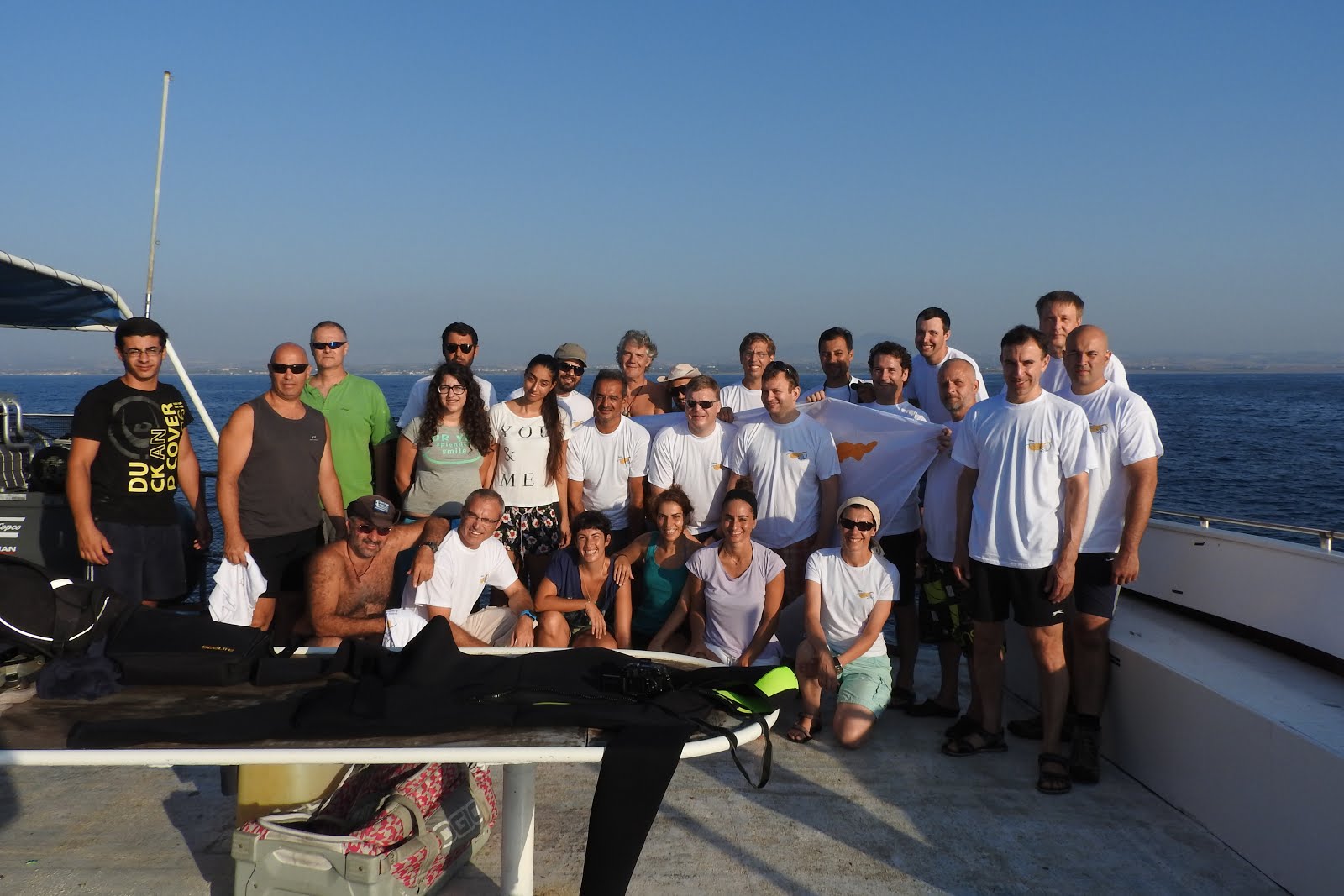
Mazotos Fieldcamp 2016 on upper deck of M/S Queen Zenobia
We were all advised to bring our fieldcamp T-shirts for group photo in the boat, but to wear them only for the photo so that they would not get dirty on the way or before the evening. Most of us were able to do that, but not all.

The main event for today was the Mazotos evening. First we met in the class room and gave our trench presentations. Then we got final reports for the course, and NAS-credit reports.
Teemu receives final report card from Rachel.
After that things became interesting. We moved to the village center where some 200 people were gathered (whole village?). This seemed to be a day, when the village gave awards for all best students at about all grades in the school system, as well as rewarding local University graduates, and Mazotos field school graduates!
The whole village came to respect their best students and us. 
We were each asked to come one by one at the podium, where we received the Fieldschool diploma from Stella and Mark, and a Commemorative from Mazotos Community Council. Stella and Mark had a speech, and then we showed a 5 minute video on Mazotos Fieldschool. The video was our "thank you" to the Mazotos village and it's people for hosting us in this expedition. Chris was so excited about making that video, that he even skipped one dive yesterday to work on it. Video was very good, but I would not have sacrificed a Mazotos dive for making it...

After the video presentation was local culture's turn. First, a choir sang very many local folk songs, and then there was turn for local folk dances.

Choir singing traditional Cyprus folk songs. (I know - my flash is weak, and I have no Photoshop)
Traditional Cyprus dancing with traditional clothing
Some of us got hungry when the dance presentations were starting and snugged out to eat at our usual tavern. No beer even on graduation day, because we dive tomorrow. We were a little surprised when Mark promised to put in his tab. He must be very tired...  or just very satisfied!

Evening got so late that I got 20 minute later departure time than usually. That was nice. I will be now well rested.

Thursday, September 1, 2016

More airlift work and the other anchor stock weight

Thursday 1.9.2016

The project had success today as also the second anchor stock lead weight was found. The bow had four teams working on it, because it seems to give much promise now. Some teams exposed more of the hull. Jouni, Nick and me were excavating the new lead weight and its surrounding area.

Jouni excavating with his paddle-brush invention. It is kind of a spork. It has a excavation paddle on one side and a paint brush on the other side, all put together with always reliable duct tape. Robert found it innovative, and immediately took my 1st prototype  into use. This is the 2nd prototype.
We worked in a different way now. I was holding the airlift, and Jouni was excavating in front of me. Nick was trying to use the other airlift to clear some of the dust away. He first moved it on one side of the excavation, and when that did not really help, he tried another position. And then he put it away.

This way of excavation went very well. It is clearly easier with two than alone. Jouni first picked the spot to excavate, and positioned himself there properly. I then moved opposite to him with the airlift, and just laid down on bottom. We knew we were excavating a pretty small area, and the bottom around was free from finds. Jouni probably saw the excavation area well, but I was pretty much in the dust cloud most of the time. Every now and then Jouni picked up the airlift head, and moved it 20-30 cm to this direction or that. And then I just kept it there. We think that we were able expose the lead weight completely. Or Jouni thinks, I did not really see that much...

Finally Nick rang the 20 minute bell, I returned the airlift hose to its station, and we ascended to the three trapezes for deco. There is a separate trapeze for each deco depth: 12m, 9m and 6m.
Airlift hose station. The handle is there to turn the airlift on/off and the hose head is hooked to one of the metal handles.
There is a little bit melancholy in the air, as the fieldcamp will close tomorrow evening with final team presentations. Some of the divers had already today their last Mazotos dive, as Christos tries to give everyone 48 hours between the last dive and the flight out. Playing it safe all the way to the end. I will continue diving every day for two more weeks, except for off-gas days once a week or so.

Each trench team is working on their presentations tonight and tomorrow afternoons. Our team had to select a name for it (right!) and our's is aptly "Bow and Arrow", with a word play both on words. The latter defers to the North Arrow, which we use when making archive photographs of finds in situ. Clever, right!